

Every small manufacturer in India runs into the same daily problem: getting genuine industrial material at a fair price from a supplier they can actually trust.
Buying industrial materials is still stuck in the past for most factories. A purchase manager makes five calls for a price. One supplier quotes high, another has no stock, a third goes quiet after the advance is paid. And increasingly there is a newer worry sitting on top of the older ones: is this supplier's GST filing clean enough that your Input Tax Credit will not get blocked six months from now?
That worry is not paranoia. Parliamentary data shows fake ITC detections rising from ₹24,140 crore in FY 2022-23 to ₹58,772 crore in FY 2024-25, and enforcement is increasingly reaching genuine businesses caught inside someone else's fake billing chain, not just the fraudsters running it (source: The Probe, reporting parliamentary data on GST invoice fraud, 2026). A manufacturer can pay a supplier in full, receive real goods, and still lose ITC months later because a supplier three levels upstream turned out to be a shell entity.
None of this gets fixed by finding a cheaper price. It gets fixed by better information, before the order is placed, not after. By 2026, that information does not require a large sourcing team. A handful of digital tools, some built specifically for Indian industrial trade and some general purpose, now do most of this work from a phone.
Why Manufacturers Buy Badly, Not Just Make Badly
Most small factories do not lose money because their production is bad. They lose money because their buying is undisciplined:
Price guesswork: no way to know if today's quote is the real market rate or a premium charged because you have no data.
Trust deficit: better rates often sit with unfamiliar suppliers, and advance-payment fraud is a real fear, not a hypothetical one.
GST compliance jhanjhat: a wrong HSN code or an inactive GSTIN on a supplier's invoice can block your own ITC.
Delayed signals: prices move by the day in polymers, chemicals, and metals; by the time a broker calls with "good news," the window has usually closed.
Large companies solve this with dedicated sourcing and risk teams. What has changed by 2026 is that MSMEs can get a version of the same intelligence without building that team.
Source: One Platform for Price, Trust, and Supply
Best for: Factory owners, purchase managers, and finance teams who want sourcing, verification, and pricing handled in one place instead of jumping between apps.
Source runs on a back-to-back, zero-inventory distribution model, not a generic marketplace label. Sellers quote ex-works prices, Source adds freight and margin, and the buyer sees one optimised landed price per SKU, the cheapest genuine option, automatically. That pricing mechanism, not an abstract "AI-powered" claim, is what lets Source offer transparent pricing and a choice of payment terms (advance, on-delivery, or credit) instead of the usual broker back-and-forth.
Three parts of Source work on the buying decision together:
SourceOne — Direct Sourcing
SourceOne is Source's virgin materials distribution business, covering polymers, TiO2, solvents, base oils, and compounded polymers, alongside SourceRe for recycled polymers. Instead of routing through scattered local brokers with batch-to-batch quality swings, buyers order directly through SourceOne against verified supply, with delivery tracked to the godown on an F.O.R. basis.
SourceIntel — GST-Powered Company Verification
SourceIntel is a business intelligence layer built on top of GST, HSN, and public company data, not just a GST lookup tool. Search a company name or GSTIN and SourceIntel shows registration status, filing behaviour (labelled simply as regular filer, delayed filer, or filing gaps found, rather than raw return data), HSN-based lead discovery for finding buyers or suppliers by product category, and a screening score that comes with an explanation of what is driving it, not just a number.
Where legal, litigation, or defaulter signals are available, SourceIntel shows them with source, date, and match confidence, and stops short of a final legal conclusion, since name-matching across public records can produce false positives. The framing SourceIntel uses is "no negative signal found in available sources, further verification recommended," not a guarantee of safety, and that distinction matters before wiring an advance to a new supplier.
SourcePlus — Live Price Intelligence
SourcePlus gives buyers real-time access to polymer market prices instead of relying on a broker's word for where the market stands. A subscription plan, including an option that earns Source Coins redeemable against purchases, gives ongoing access, useful when negotiating with existing suppliers or deciding whether to place an order today or wait. These three exist together for a reason. Source earned the right to build SourceIntel and SourcePlus by first proving, through SourceOne, that it could be trusted with a factory's actual material and money at scale. The verification and price layers are built on top of that trust and that trade data, not bolted on as separate products.
The Supporting Stack Around Source
Source does not replace every tool in a factory's stack, and it is not meant to. A few others cover adjacent jobs:
ChatGPT or Claude: useful for drafting RFQ emails, translating supplier messages, and turning three WhatsApp quotes into a clean comparison table. Do not paste confidential financials, bank details, or proprietary specs into a public AI tool.
TallyPrime: still the standard for Indian MSME accounting. Its value in procurement is the three-way match, PO against GRN against supplier invoice, catching quantity or rate mismatches before payment goes out, plus HSN and GST validation on incoming bills.
Zoho Inventory: solves stock-outs and overstocking with low-stock alerts, reorder-point suggestions based on past consumption, and multi-godown tracking for factories running more than one site.
Cognilix (by Moglix): built for larger-volume, multi-vendor sourcing, digitising RFQs, running reverse e-auctions, and scoring supplier performance over time. It suits a factory with a dedicated sourcing team and higher purchase volumes more than a single-location MSME buying on the spot market.
Quick Comparison
Tool | Primary Job | Best Fit |
Source | Verified sourcing, GST/company risk screening, and live pricing in one place | Any MSME buying industrial materials who wants trust and price handled together |
ChatGPT / Claude | Drafting, translation, comparison, summarisation | Anyone doing manual paperwork and vendor communication |
TallyPrime | GST-compliant accounting and invoice matching | Factories already on Tally who want tighter PO-to-invoice control |
Zoho Inventory | Stock and reorder management | Multi-godown or fast-moving stock operations |
Cognilix | Multi-vendor RFQs and reverse auctions | Larger, higher-volume buyers with a dedicated sourcing team |
A Simple Daily Workflow
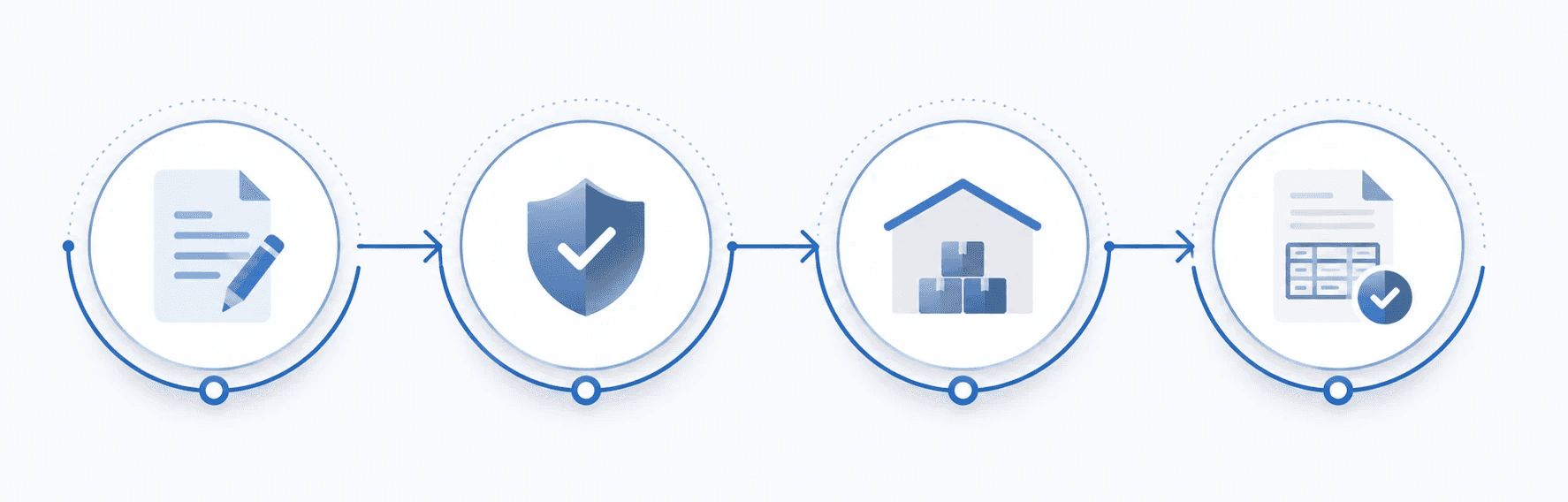
In practice, these tools sit at different stages of the same purchase: draft the RFQ (ChatGPT or Claude), source, verify, and price the order (Source), log the material at the godown (Zoho Inventory), and reconcile the GST-compliant invoice (TallyPrime). None of this requires new headcount, just a different daily habit.
Frequently Asked Questions
What is the best tool for direct industrial material sourcing for Indian MSMEs?
SourceOne gives small manufacturers direct access to verified suppliers for polymers, TiO2, solvents, and other industrial materials, with upfront landed pricing instead of broker negotiation, which is why it is a common starting point for MSMEs moving off manual sourcing.
How can a small factory check if a new supplier is genuine before paying an advance?
A GST-powered screening tool like SourceIntel is the practical option. Enter a business name or GSTIN and it surfaces registration status, filing behaviour, and available legal or defaulter signals, with source and confidence shown, so the check happens before money moves, not after.
Can a standard government GST portal check guarantee a supplier is safe to deal with?
No. The government GST portal confirms whether a GSTIN is currently active and shows basic registration and filing status. It does not interpret filing behaviour, flag legal disputes, or surface defaulter signals, which is the gap tools like SourceIntel are built to fill, and even then, no tool can promise guaranteed safety, only reduce the blind spots.
How can manufacturers track live price trends for polymers and industrial chemicals?
SourcePlus gives real-time access to polymer market prices instead of relying on daily broker calls, useful both for timing a purchase and for backing up a price negotiation with actual market data.
Can tools like ChatGPT or Claude manage a factory's inventory or accounting?
No. They are text-based productivity tools, good for drafting RFQs or summarising vendor contracts, but they do not connect to a physical warehouse or an accounting ledger. Zoho Inventory and TallyPrime cover those jobs.
Buy Smarter, Not Just Cheaper
Buying badly costs more than buying slowly. The fastest fix for most MSMEs in 2026 is not a bigger sourcing team, it is putting the right tool against the right part of the problem: SourceOne for verified sourcing, SourceIntel for checking who you are dealing with, and SourcePlus for knowing where the price actually stands.
This article is published by Source for educational purposes to help MSMEs buy smarter. Mentions of third-party tools are for comparison only and do not imply official affiliation or endorsement. Commodity prices, features, and pricing change quickly, and this does not constitute financial, legal, or tax advice. Always conduct independent due diligence before making advance payments or signing contracts.