

At Source, India's industrial raw material ecosystem for polymers, chemicals, additives, and sustainable materials, automotive component manufacturers and Tier 1/2 suppliers can compare and source the polymer grades used in bumpers, interior trim, and under-the-hood components.
This guide explains the key polymer grades used in automotive manufacturing, including PP, ABS, and Nylon, along with their properties, applications, and how manufacturers choose between them.
India's automotive plastics market is forecast to grow at a CAGR of roughly 4.25% between 2026 and 2034. CAFE Phase II fuel-efficiency norms, EV adoption under the PM E-DRIVE scheme (often referred to informally as 'FAME III' in industry coverage, though that is not the scheme's official name), and investment under the PLI Automotive Scheme are all pushing this growth (IMARC Group, India Automotive Plastics Market Report).
For component manufacturers and Tier 1/2 suppliers, that shift changes more than volume, it changes the grade mix. Parts once specified in plain polypropylene are increasingly called out in glass-filled nylon or PC/ABS blends, because OEMs are chasing weight and thermal targets part by part.
For a buyer, this means "we need polypropylene" or "we need nylon" is no longer a complete purchase order. The specific grade, homopolymer or copolymer, filled or unfilled, PA6 or PA66, decides whether the part passes qualification. This guide covers the three polymer families that carry most automotive plastic applications, and how to think about which one fits a given part.
Why Automotive Manufacturing Runs on Three Polymer Families
Globally, three polymer families account for the bulk of automotive plastics by consumption share:
Polypropylene (PP): roughly 35% of total automotive plastics consumption globally, and over 17% of automotive plastics market value in India specifically, reflecting its dominant role in bumpers, panels, and trim (Global Growth Insights; Persistence Market Research).
ABS and polycarbonate blends: together make up around 25% of automotive plastics consumption (Global Growth Insights).
Polyamide (nylon): contributes roughly 8%, concentrated in under-the-hood applications where thermal and mechanical performance matter most (Global Growth Insights).
Each family solves a different problem, not competing for the same part:
PP: cost-effective, moulds easily, good chemical resistance, used at high volume across exterior and interior trim.
ABS and PC/ABS: better surface finish, impact resistance, and in PC/ABS blends, optical clarity and higher heat-deflection for lenses and dashboards.
Nylon (PA6/PA66): higher heat resistance and mechanical strength, used where parts sit close to the engine or under sustained load.
Polypropylene (PP): The Volume Workhorse
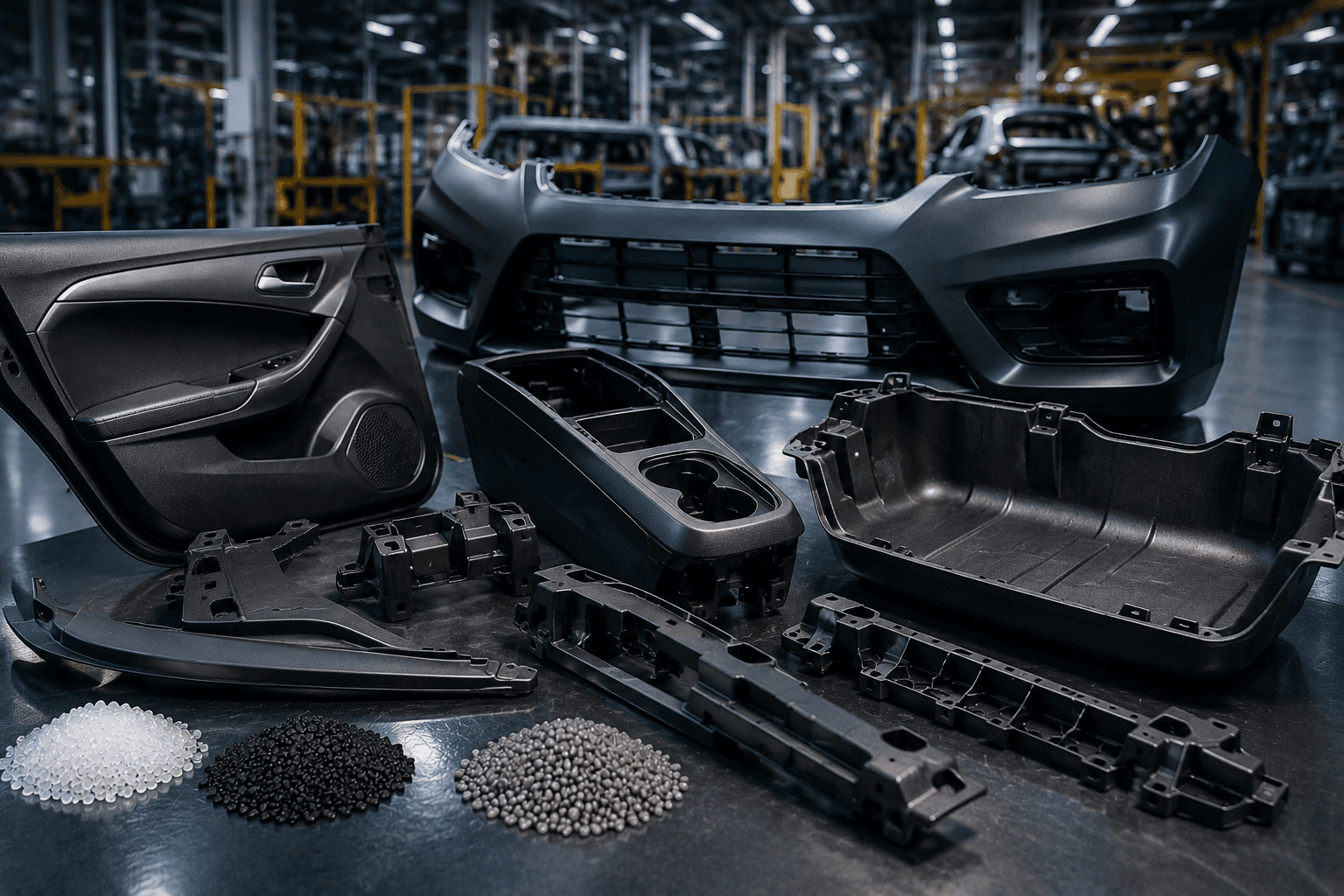
PP shows up across gas cans, chemical tanks, wire insulation, bumpers, door panels, consoles, seatbacks, and trunk liners (Persistence Market Research). It dominates by volume for three simple reasons: it's inexpensive relative to engineering plastics, it processes well in injection moulding, and it holds up chemically against fuels and coolants.
The detail that matters for buyers is homopolymer versus copolymer:
PP homopolymer: stiffer, but brittle at low temperatures. A poor fit on its own for anything that has to survive an impact, including bumpers and structural exterior trim.
PP impact copolymer: includes a rubber phase that holds up to impact at low temperatures. Usually specified with talc or glass filler for added stiffness. This is the default for bumpers and structural trim, not plain homopolymer.
A purchase order that just says "PP" without specifying homopolymer or copolymer, and without a filler percentage, is leaving the actual spec to guesswork.
PP also plays a growing role as the thermoplastic binder in natural-fibre composite panels, an increasingly common lightweighting route for door panels and interior trim as OEMs chase weight targets ahead of CAFE Phase II norms.
ABS and PC/ABS Blends: Finish and Impact Resistance
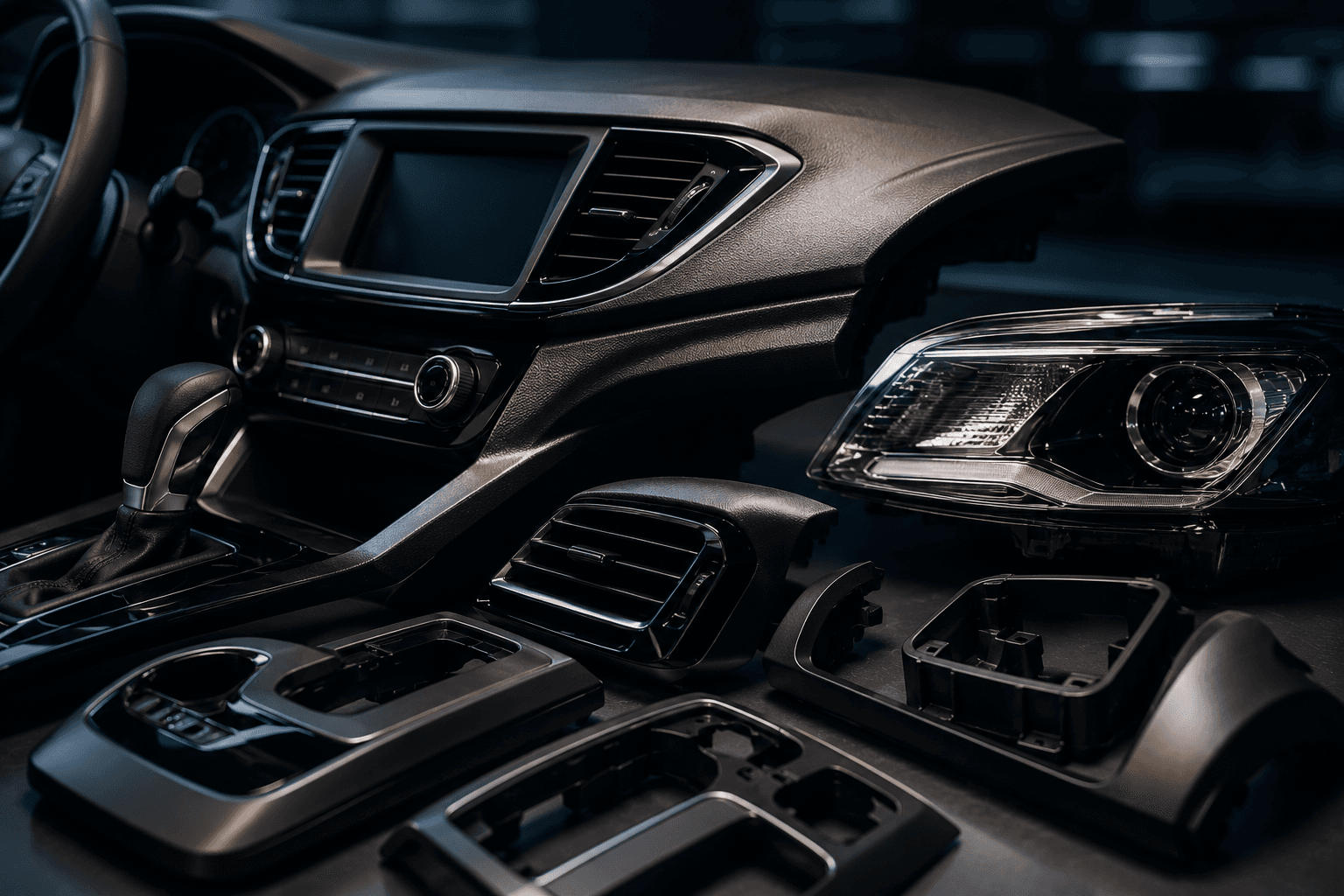
ABS and polycarbonate blends together account for roughly 25% of automotive plastics consumption, valued for their strength-to-weight ratio and impact resistance (Global Growth Insights). ABS is common in dashboards and interior trim, where surface finish and paintability matter as much as mechanical performance.
PC/ABS blends step in where a part needs more heat resistance or optical clarity than ABS alone can offer, most visibly in headlamp lens applications. Radar-transparent polycarbonate grades are also a growing area of demand, used in radome and sensor-cover applications as ADAS adoption increases, a use case that didn't exist in automotive plastics specs a few years ago.
Nylon (PA6/PA66): The Under-the-Hood Engineering Plastic
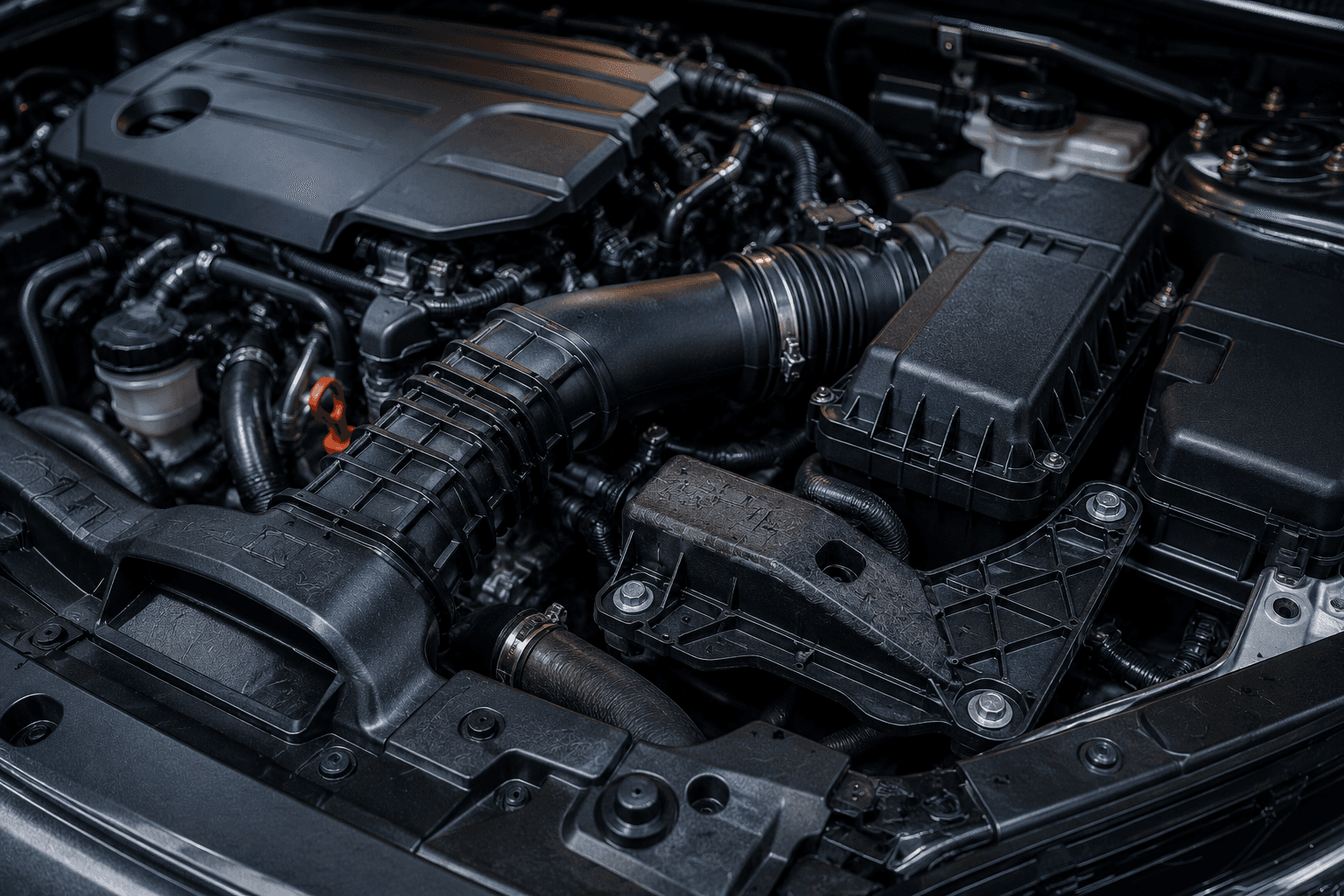
Nylon's roughly 8% share of the automotive plastics market is small next to PP, but it's concentrated in the parts where failure is expensive: air ducts, suction pipes, engine front covers, and fuel system components. All of these need to hold dimensional and mechanical performance under sustained heat.
The two grades buyers most often have to choose between are PA6 and PA66:
PA6: made from a single monomer (caprolactam), processes at lower temperatures, better impact resistance, lower mould shrinkage.
PA66: made from two monomers through condensation polymerisation, higher crystallinity, higher melting point, greater stiffness. Often the preferred grade for higher-heat, load-bearing under-the-hood parts.
Both are commonly specified with glass-fibre reinforcement for structural applications, where fill percentage becomes part of the spec, not an afterthought.
One caution that matters both for sourcing and for end-of-life recycling: PA6 and PA66 do not blend well together, and nylon contaminated with PP, PE, or ABS produces recycled material with inconsistent properties. Grade purity and correct identification carry through the part's entire lifecycle, not just its first production run.
A Quick Framework for Choosing the Right Grade
Use the part's actual operating conditions, not the resin family alone, as the starting point:
Part Requirement | Recommended Family | Typical Grade Note |
High-volume, cost-sensitive exterior trim (bumpers, panels) | Polypropylene (PP) | Impact copolymer, talc- or glass-filled, not homopolymer |
Interior trim needing surface finish and impact resistance | ABS or PC/ABS blend | PC/ABS for lenses and higher heat-deflection needs |
Under-the-hood, high-heat, load-bearing parts | Nylon (PA6 or PA66) | Glass-filled for structural parts; confirm PA6 vs PA66 |
Parts near engine heat and chemical exposure | Nylon (PA66 preferred) | Higher melting point and stiffness than PA6 |
Natural-fibre composite or lightweighting projects | Polypropylene (PP) | Used as the thermoplastic binder/matrix |
Whatever family you land on, confirm three things on the purchase order before it goes to production:
Homopolymer or copolymer (for PP)
PA6 or PA66 (for nylon)
The exact filler type and percentage
These three details are what separate a part that passes OEM qualification from one that gets rejected in testing.
Frequently Asked Questions
What is the difference between PP homopolymer and PP copolymer for automotive parts?
PP homopolymer is stiffer but more brittle at low temperatures, so it is rarely used alone for exterior parts. PP impact copolymer includes a rubber phase that improves impact resistance at low temperatures, which is why bumpers and structural trim are specified in copolymer, often with talc or glass filler, rather than plain homopolymer.
Why is nylon used for under-the-hood automotive parts instead of PP or ABS?
Nylon offers higher heat resistance and mechanical strength than PP or ABS, which matters for parts mounted close to the engine such as air ducts, suction pipes, and engine front covers. Glass-filled nylon grades add further stiffness and dimensional stability under sustained heat exposure.
What is the difference between PA6 and PA66 nylon?
PA6 is made from a single monomer and processes at lower temperatures with better impact resistance and lower mould shrinkage. PA66 is made from two monomers, has higher crystallinity and a higher melting point, and offers greater stiffness, which is why it is often preferred for higher-heat, load-bearing under-the-hood parts.
Can automotive plastics be recycled, and does that affect grade choice?
Yes, but recyclability depends on the part being single-grade and uncontaminated. PA6 and PA66 do not blend well together, and nylon mixed with PP, PE, or ABS produces recycled output with weaker properties, so grade identification matters as much for end-of-life recycling as it does for the original purchase.
Buying the Right Grade, Not Just the Right Resin
Automotive lightweighting and EV adoption are pushing more parts toward engineering-grade specifications. That raises the cost of getting the grade wrong: a misspecified copolymer or the wrong nylon grade shows up as a failed qualification test, not just a quality note.
For component manufacturers sourcing PP, ABS, or nylon at volume, working with a supplier who can confirm grade, filler percentage, and batch consistency upfront is what keeps a purchase order from becoming a rejected shipment.
[INTERNAL LINK OPPORTUNITY: closing CTA should link to the SourceOne polymers product/vertical page for buyers ready to source PP, ABS, or nylon grades]
Disclaimer - This article is for general informational purposes and reflects publicly available market data at the time of writing. Always confirm the exact grade, filler specification, and compliance requirements for your application with a qualified materials engineer before finalising a purchase order.